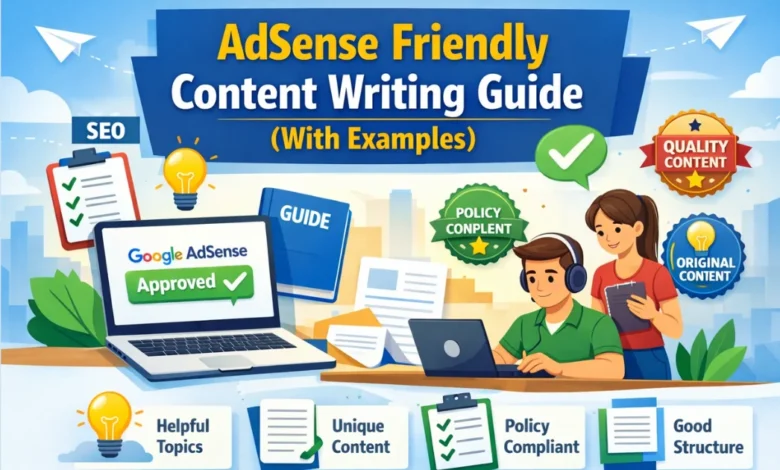
AdSense Friendly Content Writing Guide (With Examples)
Getting approved for Google AdSense is not just about traffic or website age. One of the biggest deciding factors is content quality. Many websites fail AdSense approval simply because their content does not meet Google’s quality standards.
This guide will show you how to write AdSense-friendly content, what Google really looks for, and real examples of good vs bad content—so you can avoid rejection and build long-term trust.
What Is AdSense Friendly Content?
AdSense-friendly content is content that:
- Provides real value to users
- Is original, helpful, and well-structured
- Follows Google content policies
- Is written for humans first, not bots
Google wants to place ads on websites that users trust and engage with. If your content looks thin, copied, misleading, or spammy, AdSense approval becomes very difficult.
Why Content Quality Matters for AdSense Approval
Google reviews your website manually and algorithmically. During review, Google checks:
- Content originality
- Topic usefulness
- Page structure and readability
- User experience
- Trust signals (About, Contact, policies)
Even with 0 traffic, high-quality content can get approved—but poor content almost always fails.
Core Principles of AdSense Friendly Content
1. Write for Users, Not for AdSense
❌ Wrong approach:
“I am writing this article only to get AdSense approval.”
✅ Right approach:
“I am solving a real problem for readers.”
Google easily detects content created only for ads.
2. Choose Informational & Helpful Topics
Best AdSense-friendly content types:
- How-to guides
- Tutorials
- Problem-solution articles
- FAQs
- Educational posts
❌ Avoid:
- Auto-generated content
- Copied answers
- Thin affiliate pages
- Rewritten AI spam
3. Minimum Word Count (Quality Over Quantity)
There is no fixed word limit, but generally:
- 800–1500 words for main articles works well
- Short posts must still be complete and useful
A 600-word helpful article is better than a 2,000-word useless one.
4. Proper Structure & Headings (SEO + UX)
Use clear headings:
- H1 → Main title
- H2 → Main sections
- H3 → Sub-points
Example structure:
H1: AdSense Friendly Content Writing Guide
H2: What Is AdSense Friendly Content?
H2: Why Content Quality Matters
H2: Common Mistakes
H2: Examples
This improves SEO, readability, and AdSense trust.
AdSense Friendly Writing Style
Use Simple & Clear Language
Write like you are explaining to a beginner.
❌ Bad:
“Content monetization through contextual advertising mechanisms…”
✅ Good:
“Google AdSense shows ads related to your content.”
Avoid Keyword Stuffing
❌ Bad:
“AdSense friendly content guide AdSense friendly article AdSense content writing…”
✅ Good:
Use the keyword naturally 2–4 times.
Google penalizes unnatural repetition.
Add Real Value (Not Filler)
Every paragraph should:
- Answer a question
- Explain a concept
- Solve a problem
If a sentence adds no value—remove it.
Examples: Bad vs Good AdSense Content
❌ Bad Content Example
“AdSense approval is easy. Just create a website and apply. Google AdSense approval is fast and simple. Everyone can get AdSense.”
Why this fails:
- No explanation
- No originality
- No user value
- Sounds spammy
✅ Good Content Example
“Google AdSense approval depends on content quality, website structure, and policy compliance. New websites can get approved if they publish original, helpful articles and include essential pages like About, Privacy Policy, and Contact.”
Why this works:
- Clear explanation
- Helpful
- Trust-focused
- Informational
Pages You MUST Have for AdSense
Even great content fails without these pages:
- About Us
- Contact Us
- Privacy Policy
- Terms & Conditions (recommended)
These pages increase trust and legitimacy.
Common Content Mistakes That Cause AdSense Rejection
Avoid these at all costs:
- Copied or spun content
- AI content without human editing
- Thin posts (200–300 words)
- Misleading titles
- Grammar-filled content
- Over-optimized keywords
- Affiliate links on every page
How Many Articles Are Enough for AdSense?
There’s no official number, but a safe range is:
- 15–30 high-quality articles
- Focus on one clear niche
- Publish consistently
Quality always beats quantity.
SEO Tips for AdSense Friendly Content
- Use 1 main keyword per article
- Write a natural meta title & description
- Add internal links
- Use short paragraphs
- Optimize images (alt text)
- Fast page loading
SEO + AdSense go hand in hand.
Final Checklist Before Applying for AdSense
Before submitting your site:
- ✅ Original, helpful content
- ✅ Clear niche
- ✅ No copied text
- ✅ Policy pages added
- ✅ Clean design
- ✅ Mobile friendly
- ✅ Easy navigation
If all are checked, your chances improve significantly.
Final Thoughts
AdSense approval is not about tricks—it’s about trust.
When you focus on:
- Helping users
- Writing clean, honest content
- Following Google guidelines
AdSense approval becomes natural, not stressful.
👉 Pro tip: Write content as if ads never existed—Google loves that.